Skip to content
Streambay
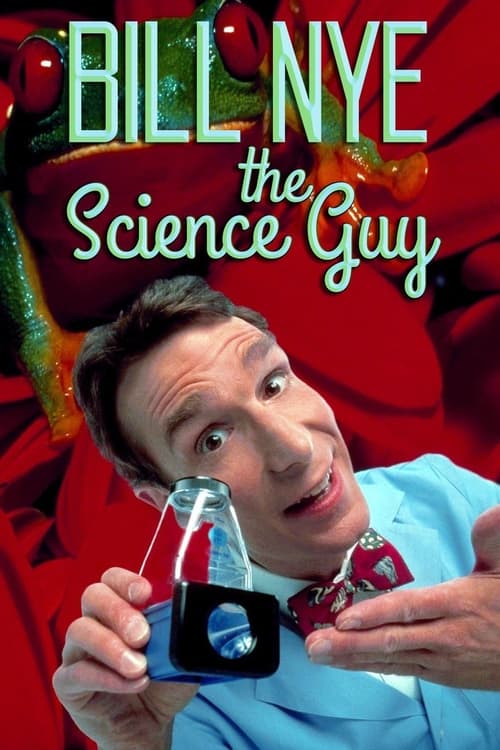
Bill Nye the Science Guy poster
TV series

Bill Nye the Science Guy

Latest episode

S5 E20 · Motion

About Bill Nye the Science Guy

Bill Nye the Science Guy is a kids and comedy TV series that premiered on PBS on September 10, 1993. It has 5 seasons and 100 episodes so far and has ended. The latest episode, Season 5 Episode 20 "Motion", aired on June 20, 1998.

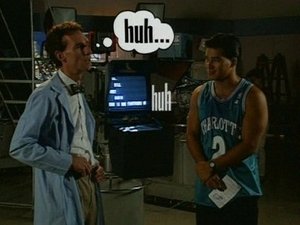
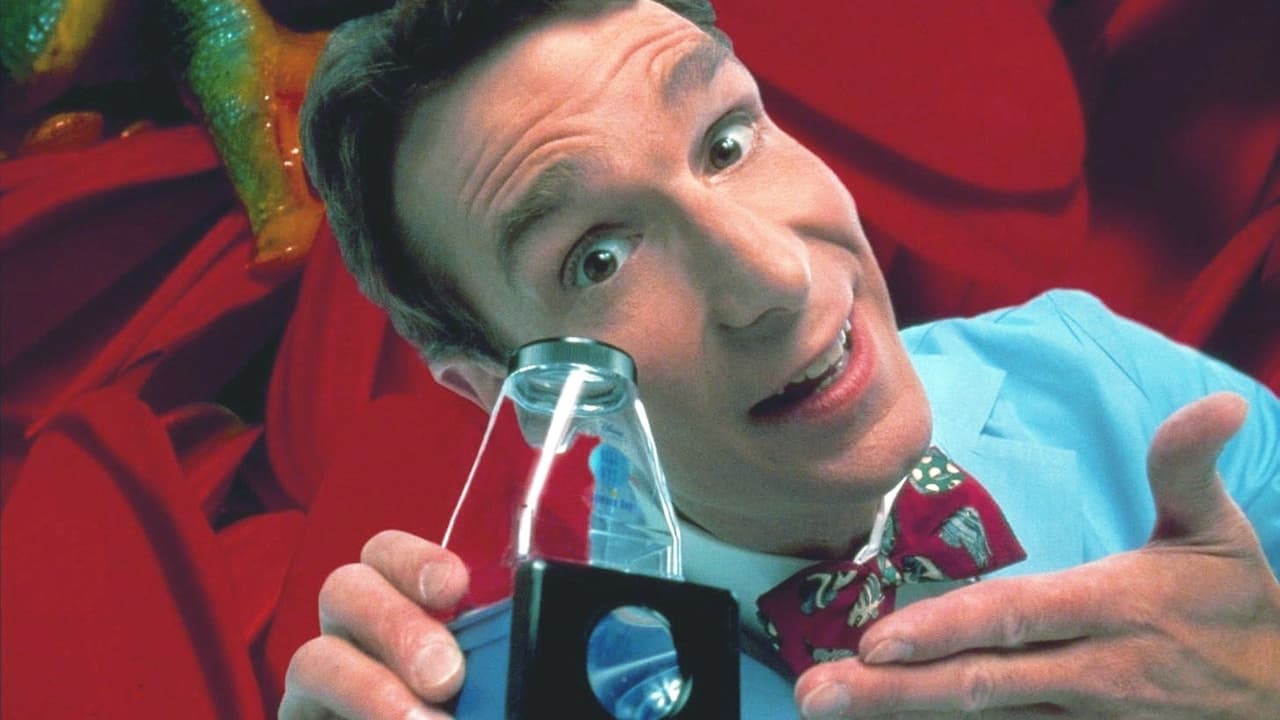
It's "Mr. Wizard" for a different decade. Bill Nye is the Science Guy, a host who's hooked on experimenting and explaining. Picking one topic per show (like the human heart or electricity), Nye gets creative with teaching kids and adults alike the nuances of science.

  • Kids
  • Comedy
  • Documentary

Last updated

Episodes

100 episodes · 5 seasons

Season 1

1993 · 20 episodes · Last episode: 32 years ago

Bill Nye the Science Guy Season 1 release dates →
  1. Bill Nye the Science Guy S1 E20 still E20

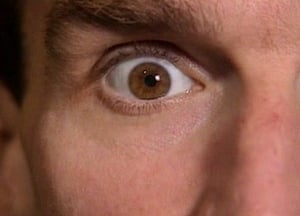
    20. Eyeball

    Finale

    Look no further ... Bill Nye is on the ball - the eyeball. For their small size, your eyes do an important job. By working with your brain, your eyes can tell the difference between thousands of different colors. They can follow a fast-moving hockey puck across the ice. They are even sending messages to your brain about what you're reading right now. Eyes work a lot like a camera. They take in light, focus light, and make images. With help from the brain, your eyes help understand the world around you. Light bouncing into your eye passes through an opening called the pupil. If you look in the mirror, your pupil is the black area in the middle of your eye. The pupil can open or close, depending on the brightness of the light. After passing the pupil, the light is focused onto the back of your eye by the lens, a thin layer of cells. On the back of your eye are special cells called rods and cones that are sensitive to light. These cells send electrical messages to your
  2. Bill Nye the Science Guy S1 E19 still E19

    19. Outer Space

    The show is way out there, way far away. After all, it's in Outer Space. When you look at the night sky on a clear dark night, you can see thousands of stars. There are far more than you could count. And, they are way out there. They are very, very far away. It's about the hardest thing to imagine about space. Let's talk about the nearest star to us, the Sun. If somehow outer space were not an icy cold vacuum with nothing to eat, drink, or breathe, and we could drive there in a car, to get to the Sun at freeway speed of 100 kilometers/hour (61 miles/hour), it would take171 years of driving without stopping to sleep or get gas out in the near nothingness of space. That's just to the Sun. To get to even the closest star, Proxima Centauri, would take 40,000 years. On top of that, most things, billions and billions of stars, are much, much farther away than that! It is just astonishing. How do we know that everything is so far away? We have watched the sky for centuries.

  3. Bill Nye the Science Guy S1 E18 still E18

    18. Electricity

    It's time for Bill Nye to shed a little light on electricity. Electricity might seem mysterious, but once you understand the science the light goes on (so to speak). You flip a switch, and the lights turn on. You push the play button, and your personal stereo starts playing music. When you flip the switch or push play, you start a flow of electrons. Electricity is the flow of electrons, and electrons are very tiny charged particles. Electrons are found in atoms, the tiny pieces that all stuff is made from. We can make electrons flow in two ways. Batteries make electricity by mixing up chemicals -- making a chemical reaction that forces electrons to move in a path from the battery to the personal stereo and back to the battery. Electricity that turns on lights in your home is made by power plants. Most power plants use big machines called generators to make electrons by twirling wire in a magnet. The magnet makes electrons in the wire move around, creating electricity.

  4. Bill Nye the Science Guy S1 E17 still E17

    17. Cells

    You can't see them, but they're everywhere even inside Bill Nye. This is not science fiction, it's the science of cells. All things that live are made from cells. You can't see them, but every part of your body, including everything inside your body, is made from cells. Cells eat, they grow, and they make more of themselves (what scientists call replicate). There are millions of different types of cells. Dog cells are different from fish cells. Bird cells are different from your cells. And inside your body, there are many different cells, each one doing a different job to keep your body going. Cells may be tiny, but without them, we'd be nothing.

  5. Bill Nye the Science Guy S1 E16 still E16

    16. Light & Color

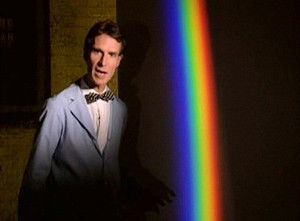
    Lighten up. It's the ""Light and Color"" episode. Without light, we wouldn't be able to see. It would be like living in a room with no windows, doors, or lamps. There's an old saying, ""We don't see things; we see light bouncing off of things."" We see things, and colors, when light bounces off things and into our eyes. White light, like the light from the Sun, is made up of all the different colors of light blended together. When white light hits something white, almost all of the light bounces into our eyes, and we see the color white. Things are different colors because some light bounces off and other light gets absorbed. An orange is orange because it absorbs all different colors of light except orange light. Grass is green because it absorbs all different colors of light except green light. Bill Nye's lab coat is blue because it absorbs all different colors of light except blue light. All colors, including black, are made in the same way. It's just a matter of ref

  6. Bill Nye the Science Guy S1 E15 still E15

    15. Earth's Seasons

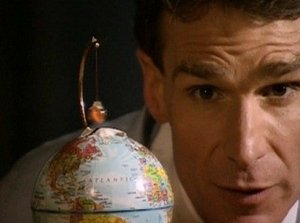
    It doesn't matter if it's spring, summer, winter, or fall - Bill Nye is always in season. Every year, we experience the seasons. Some months have snow and rain, while other months have warmth and sunshine. Temperatures go from cold, to woarm, to cold again – winter, spring, summer, and fall. The cycle of the seasons takes one year, and the Earth takes one year to go around the sun. Coincidence? No way. The Earth's orbit around the Sun is flat, as though our planet were spinning over a tabletop. Compared with flat plane of its orbit, the Earth is tilted. Its axis, the imaginary line between the North and South Poles, is tipped over a bit. In June, the north half of the Earth (the Northern Hemisphere) is tilted toward the Sun, and it's summertime in places like Nye Labs in the United States. Meanwhile, the south half (the Southern Hemisphere) is tilted away from the Sun, and it's winter there, in places like Australia and South Africa. The Earth's orbit isn't quite

  7. Bill Nye the Science Guy S1 E14 still E14

    14. Structures

    Are you tense? Need some structure to your life? Then tune in to Bill Nye the Science Guy as he explains the science of structures. All structures give support or create a shape. You can find structures everywhere. Bridges, buildings, chairs, shoes, plants, spiderwebs, tables, and even your own body are all structures. A structure's shape, size, and what it's made of depend on what the structure does and how strong it needs to be. When structures give support, they either experience a pull (tension) or a push (compression). Structures in tension, such as ropes, cables, or blimps are made from stuff that is good at pulling. The materials in tension are usually thin. Structures under compression, such as elephant legs and courthouse columns, are made from hard stiff stuff. Compared to structures under tension, structures under compression are much thicker. When it comes to structures, form (the size and shape) depends on function (what it does). Build support for Bill
  8. Bill Nye the Science Guy S1 E13 still E13

    13. Garbage

    Garbage is a look at two different kinds of garbage -- biodegradable and non-biodegradable. Nye emphasizes the importance of recycling and cutting down on the amount of the waste that cannot break down. The music video "Recycle" has a familiar melody, taken from "Respect," the Aretha Franklin hit.

  9. Bill Nye the Science Guy S1 E12 still E12

    12. Sound

    Listen up, scientists. Bill Nye is here to make some noise in the ""Sound"" episode. Your vocal cords do it. Speakers playing rock music do it. Even a school bell does it. They all vibrate; and that's how sound is made. Plucking a stretched rubber band makes the rubber band vibrate. Air molecules around the rubber band move, pushing other air molecules. As the rubber band continues to vibrate, it sends waves of sound through the air. It's a lot like the ripples you see when you drop a rock into a pond. You hear sound when rippling air pushes on tiny bones in your ears. Nerves in your ears send a message to your brain about the sound you're hearing. Different sounds make different patterns of waves with different distances between them. Plucking, banging, whispering, and yelling are all vibrations in air, yet they all sound very different. Sound vibrations can be thought of as waves moving through molecules. Low-pitched sounds have big gaps between waves, while high-pi
  10. Bill Nye the Science Guy S1 E11 still E11

    11. The Moon

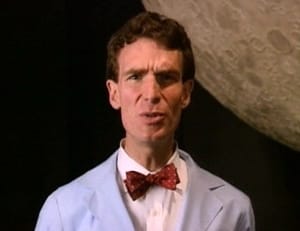
    Let the moon master Bill Nye teach you the ancient and not-so-ancient secrets of the Moon. Wax on, wax off. The Moon grows bigger (waxes) and smaller (wanes) every 30 days or so. The word ""month"" comes from the word ""moon"". The Moon is the closest thing in space to Earth, and it's one of the most well-studied orbs in our solar system. We know that Moon rocks are rich in calcium and aluminum, that the Moon has no atmosphere, and that there are over a million craters on the Moon's surface. The Moon doesn't glow on its own, it reflects sunlight. Watch the Moon every night for a month as it grows, shrinks, and at one point disappears. The Moon doesn't actually change it's shape. It's the way the sun shines on the part of the Moon we see that makes the phases change. The Earth moves around the Sun, the Moon moves around the Earth. As the Moon moves through its orbit, the Sun shines on bigger or smaller portions of it. If you were looking at the Moon from the Sun, it woul

  11. Bill Nye the Science Guy S1 E10 still E10

    10. Simple Machines

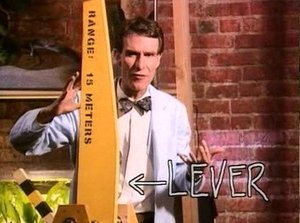
    Learning about science can be hard work, but simple machines can make it easier. Let Bill Nye push and pull you around ramps, levers, screws, and pulleys. Simple machines simply make work easier by directing forces over distances. Instead of lifting a heavy box upstairs, you can hook it to some ropes and pulleys and pull it up. Or you can get a ramp and slide it upstairs. Either way, it's less sweat to use the pulleys or the ramp than it is to lift the box straight up by yourself because the force you need is more spread out. Levers, ramps, screws, wheels, wedges, and pulleys are all simple machines designed to direct forces. With simple machines we don't have to push or pull as hard, but we have to push or pull over a longer distance. It's easier to walk up a long set of stairs to the top of the Empire State Building than it would be to climb a ladder to the top, but the set of stairs would be much longer than the ladder. Simple machines are simply scientific.

  12. Bill Nye the Science Guy S1 E9 still E9

    9. Biodiversity

    Ecosystems are areas where things live. Ecosystems that are biodiverse are home to a variety of plants and animals. A healthy ecosystem is one with a lot of biodiversity. Imagine if humans could only eat one kind of food, say corn. We'd be in big trouble if all the corn disappeared. Besides not having anything to munch on at the movies, we'd have nothing to eat at all. Luckily, our ecosystem covers a big part of the Earth, and there are lots of different plants to eat. Ecosystems are not as simple as one living thing eating another, as the corn example. The lives of animals and plants are intertwined - what happens to one animal can have an impact on all sorts of living things. As humans, we have a big effect on the other living things around us. We are the only animals to leave lots of stuff around, such as houses, cars, and malls. It's important for us to think about the choices we make and how they will affect the other living things around us. Remember: The Earth

  13. Bill Nye the Science Guy S1 E8 still E8

    8. Phases of Matter

    Bill Nye is going through a phase - a phase of matter. Check out the ""Phases of Matter"" episode to find out about rock-solid solids, liquidy liquids, and gassy gases. It's phase-tastic! Everything around us is made of stuff called matter, and all matter is made of atoms. Matter is anything that comes in three varieties, what scientists call phases. There are solids like rocks, cookies, and desks. There are liquids like water, honey, and juice. And there are gases, we breathe air and the helium in balloons. The main difference between the three phases is how fast the matter's atoms move. All atoms move around because they have energy. The more energy that's in something, the faster the atoms move. Atoms in an ice cube don't move very much - they're frozen in place. The atoms in liquid water slip and slide around - that's why you can pour it and spill it. Water vapor atoms are moving pretty fast - that's why they float around in air (a mixture of other gasses). Changing

  14. Bill Nye the Science Guy S1 E7 still E7

    7. Digestion

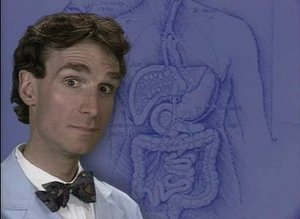
    Take time to digest this show. They say that your food is no more inside you than a pencil is inside a donut, when it's poked through the hole. Instead of the food going in you, food goes through you. But, all the energy you get to live and grow comes from your food. All the chemicals that become your body and brain as you get bigger, come from your food. You get these vital chemicals through a process called ""digestion."" Your body breaks food down and grabs all the nutrients you need from it. Then, your body gets rid of what's left over. Digestion starts in your mouth. You begin breaking food down by breaking it into pieces with your teeth and jaw muscles. Your saliva (your spit) is full of chemicals that react with the chemicals in food and make them break apart. Then you swallow. Your food goes down a tube (your esophagus) to your stomach, where powerful hydrochloric acid breaks it down further into a mushy mash we call chime (kime). From there, the chime goes in
  15. Bill Nye the Science Guy S1 E6 still E6

    6. Gravity

    Next time you throw a ball in the air, and it doesn't fly off into outer space, thank gravity. Right now, you and everything in the room where you are, is getting pulled down by gravity. If you don't believe it, push a book of your desk. It will go plummeting toward the center of the Earth. It's gravity. The Earth's mass, the stuff it's made of, creates gravity. It's pulling down on you and every other object you can see; it's even pulling down on the air and the ocean. Not only that, you and every atom of every thing around you has gravity. So, the objects and atoms are all, ever so slightly, pulling up on the Earth! Without gravity, there would be no weight. When you step on a bathroom scale, the scale is getting squeezed between you and the Earth. The scale measures how strong this mutual attraction is. Gravity makes a force that pulls objects together. Not only is gravity pulling on every atom and molecule of everything around us, it pulls over huge, gigantic di
  16. Bill Nye the Science Guy S1 E5 still E5

    5. Buoyancy

    A hot-air balln ride and a trip to the aquarium help Bill Nye explain why things float

  17. Bill Nye the Science Guy S1 E4 still E4

    4. Skin

    Learning about skin science is no sweat. It's gigantic. It's gargantuan. It's your skin. It's your body's biggest organ. If you could lay your skin out flat, it would cover about one and a half square meters. Your skin stops you from drying out, protects you from the weather, and keeps bacteria and viruses from getting inside your body. Your skin is also your personal air conditioner and heater all in one. Sweating cools you off. When you're hot, glands in your skin push a mixture of water and other chemicals onto the surface of your skin. When the water evaporates, it takes some of the heat with it, and you're cooler. When you're too cold, your skin muscles start twitching. Shivering makes your body warm up. Without skin, you wouldn't be able to feel the difference between a sheet of paper and a wool blanket. There are thousands of touch receptors inside skin. When you touch the remote control, the receptors send information about the remote's temperature, thicknes
  18. Bill Nye the Science Guy S1 E3 still E3

    3. Dinosaurs

    We can dish the real dirt about dinosaurs, thanks to fossils - traces of theses astonishing animals. Dinosaurs did not print newspapers. They did not take family snapshots or videos 65 million years ago. The only proof scientists have of dinosaurs is their fossils, especially bones. They would never have survived billions of years waiting for some human to trip over them. Luckily for paleontologists (scientists who study the past), now and then dinosaurs died, and their bones were covered by mud, or sand. As the bones sat protected from weather, they absorbed minerals from the soil around them. The minerals chemically worked their way into the bones. Millions of years later, we can find them and dig them up. Humans were not around to see what actually killed the ancient dinosaurs. Many scientists think a meteorite, or lots of meteorites, crashed into the Earth. When the space rocks hit the ground, they made big craters and kicked up a lot of dust and dirt. If enough d

  19. Bill Nye the Science Guy S1 E2 still E2

    2. Earth's Crust

    Don't just go with the flow. Settle down on the crust. Imagine a world without any crust. There would be no pies, just goopy filling, no bread, no hamburger buns, and no you or me. That's right. You, and every living thing we know of, live on or in the Earth's crust. And, living things need the Earth's crust to survive. Let's look at the science of the surface. By carefully studying the Earth's surface, scientists have discovered that the Earth is made up of gigantic layers. At the center of the Earth, there is a core – a big ball of solid metal mostly iron. The core is surrounded by a layer of liquid iron and other minerals. We usually just call it the outer core. The next layer, around the outer core is called the mantle. You may have seen a mantle above a fireplace. Well, the mantle is above the Earth's hot core places. The mantle is gooey hot nearly melted rock that flows the way asphalt does on a hot summer day. Scientists often say that the mantle is plastic. It

  20. Bill Nye the Science Guy S1 E1 still E1

    1. Flight

    Things that fly need air. Even though we walk through it, breathe it, and sneeze it, air seems to be a whole bunch of nothing. But air is there, and it's powerful. Balloons inflate because air presses on the insides and outsides of the balloon. Air pressure in tires supports the weight of bikes, buses, trucks, cars, and planes. But air doesn't need to be inside something to exert pressure. Air that moves around pushes, too. What do birds, planes, kites, Frisbees, and helicopters have in common? They fly because moving air creates lift, or a push up. Airplane wings are shaped to push air down. The momentum of the air going down pushes wings up. Air above the wing gets going faster than the air underneath. Fast-moving air zips along, without pushing as hard side to side or up and down. The slow air pushes up from below harder than the fast air pushes down from above ... and you're airborne! Every flying thing, from the tiniest flying insect to the biggest airplane, us

Season 2

1994 · 20 episodes · Last episode: 31 years ago

Bill Nye the Science Guy Season 2 release dates →
  1. Bill Nye the Science Guy S2 E20 still E20

    20. Respiration

    Finale

    How breathing supplies the body with the oxygen it needs

  2. Bill Nye the Science Guy S2 E19 still E19

    19. Atmosphere

    The air that surrounds Earth is called the atmosphere. Compared to the size of the Earth, the atmosphere is very, very thin. It’s made from gases – mainly nitrogen, oxygen, and water vapor, with a little argon, carbon dioxide, xenon, neon, helium, and sulfur. The atmosphere does a lot for Earth. It blocks ultraviolet light and burns up a lot of meteors. It traps in heat, keeping Earth cozy. Even clouds are formed in the atmosphere – keeping the Earth wet with rain.

  3. Bill Nye the Science Guy S2 E18 still E18

    18. Reptiles

    Bill Nye teaches us about reptiles.

  4. Bill Nye the Science Guy S2 E17 still E17

    17. Momentum

    The momentum of a moving thing, like you riding your bike, depends on how much mass you and your bike have and how fast you’re speeding down that hill. An elephant on a bike has more momentum than a mouse on a bike moving at the same speed. A mouse on a fast bike has more momentum than a mouse on a slow bike. If there’s an elephant on a fast bike, you’d better get out of the way.

  5. Bill Nye the Science Guy S2 E16 still E16

    16. Communication

    In this program, Bill points out the different ways in which humans and animals exchange information. He also talks about the ability of humans to store data in computers, books, and on videotapes.

  6. Bill Nye the Science Guy S2 E15 still E15

    15. Forests

    In Bill Nye the Science Guy: Forests, Nye shows students the levels of a forest, which include the canopy, the under story, and the floor. His special guest is Nalini Nadkarni, who has no qualms about going high up in the canopy to check out the wildlife and other happenings there

  7. Bill Nye the Science Guy S2 E14 still E14

    14. Brain

    Bill Nye looks at how the brain controls the body and stores information

  8. Bill Nye the Science Guy S2 E13 still E13

    13. The Sun

    The Sun is huge. It's bigger than huge. It's so big that 1.3 million Earths would fit inside a hollowed-out Sun. It's really far away, too - about 150 million kilometers (93 million miles) Even at that distance the Sun affects everything on Earth. All the energy we have comes, or once came from, the Sun. That includes energy to light a lamp, energy to kick a soccer ball, and energy in batteries that play your personal stereo. We're talking about nearly all of the energy. There's a little bit of energy that comes from nuclear reactions deep in the Earth's core. But that energy pales compared with the nuclear fusion fueling the Sun. Without the Sun, the Earth would be a big hunk of rock with nearly nothing on it. The Sun is made of gas. It has so much gravity that it's atoms are smashed into hot gas. In the sun, atoms of gas are constantly crashing into each other. When they collide, they form new atoms and release energy. Scientists call this atom smashing "nuclear fus

  9. Bill Nye the Science Guy S2 E12 still E12

    12. Balance

    Bill Nye's going to use the force to pull you into the world of balance. A force is a push or a pull. You can feel a force when someone pushes you. You can use a force to pull a door shut. Anyone can make forces by pushing and pulling, and you don't need to be Luke Skywalker to use a force. In a game of tug-of-war, if the pull of your team is the same as the pull of the other team, the forces are equal. The two teams are in balance, and the rope doesn't budge. Things are in balance when forces that are pushing or pulling them are equal. If your tug-of-war team pulls harder than the other team, the forces are not equal. The other team falls all over the place. Unequal forces make things move and twist. A lot of things are designed to take advantage of unequal forces. Wrenches, screwdrivers, door handles, and water faucets use forces made by you to do work. A well-balanced science diet starts with Bill Nye.

  10. Bill Nye the Science Guy S2 E11 still E11

    11. Insects

    Bill Nye's not here to bug you - he just wants to tell you about insects. Do you know when you're looking at an insect? All insects have six legs, three body segments, antennae, and an exoskeleton. Insects don't have bones. Instead, they have hard shells called exoskeletons. Like a little suit of armor, an exoskeleton protects the insect's body and also keeps it from drying out. Although people call any crawling critter with an exoskeleton a "bug", the "true bugs" are insects that have special mouth parts for piercing and sucking. And, spiders are not bugs or even insects. They're built differently with only two main body parts and eight legs instead of six. If you think you have a wild time growing up, take a look at an insect's life. Most insects go through at least four stages of growth -- egg (little round thing), larva (a bit like a worm), pupa (insect in a cocoon), and adult. It's a long road to maturity for an insect. Everyone's buzzing about the "Insects" episode. Don't miss it

  11. Bill Nye the Science Guy S2 E10 still E10

    10. Heat

    Things sure are heating up at Nye Labs. Snow cones, flowers, hot dogs, people -- everything is made of molecules. No matter what they're in, solid, liquid, or gas, molecules are always moving, even if just a little bit. The speed of the molecules depends on their temperature. Cold things have slow-moving molecules, while hot things have fast-moving molecules. In fact, temperature is really a measurement of molecule speed. For a cold thing to get warm, its molecules have to speed up. Heat moves in three different ways -- conduction, convection, and radiation. Conduction is the flow of heat between two solid objects that are touching. Heat conducts from your warm fingertips into a cold can of soda. Convection is the transfer of heat with a liquid or gas. A hot bath feels warm all over not just where you're sitting.

  12. Bill Nye the Science Guy S2 E9 still E9

    9. Oceanography

    Surf's up! Get the current information as Bill Nye explains why oceans are salty and explores the ocean currents. Go with the flow of ocean currents with Bill Nye the Science Guy. Most of the Earth is covered with water - we're talking 71% of the entire Earth, and most of that water is in oceans. It depends how you count, but you can say that there are five oceans on Earth - the Atlantic, the Pacific, the Indian, the Arctic, and the Antarctic. They are all connected into one World Ocean by the flow of ocean currents. Ocean water is moving around all the time. Some of the moving water forms rivers in the ocean. Oceanographers, scientists who study oceans, call these rivers of ocean water "currents". Currents help sea animals move around, they bring up deep ocean water with lots of nutrients for small animals to eat, and they push warm and cold water around, creating different climates in the oceans. As the sea surface gets warmed by the Sun, water evaporates, but salt stays in the sea.

  13. Bill Nye the Science Guy S2 E8 still E8

    8. Bones & Muscles

    In this show, you can Bone up on Muscles. When you clicked on the Nye Labs web site to read this, you used your bones and muscles. Without them, you can't click, surf, or even sigh. Bones and muscles work together, or you aren't going anywhere. Muscles always pull, even when you push on something like a door somewhere in your body your arm and leg muscles are in tension. They are all attached to bones, and those bones are pushing; they're in compression. By pulling on bones you can breathe, talk, and move all over the world. Your bones support your weight like beams of steel or wood. They're stiff and strong. Rigid as they might seem though, they do flex. And, if you bang one hard enough, it swells up. You have a lump. That's because bones are full of blood vessels. Bones are not solid like rocks or skeletons in a dinosaur museum. Bones flex and grow. In fact, putting healthy amounts of stress on your bones is good for them.

  14. Bill Nye the Science Guy S2 E7 still E7

    7. Light Optics

    Don't stay in the dark - Bill Nye will help you absorb the science of light optics. Light is energy that normally moves in a straight line, but often something gets in the way. When light runs into something, three things can happen - the light can bounce off, it can go through, or it can be absorbed. Often all three things happen at the same time. Light bounces off mirrors. You see yourself in a mirror when light bounces off your face, into the mirror, and then into your eyes. Light goes through glass. If the glass is bent or curved, the light gets bent on its way out of the glass. The glass in a magnifying glass or a pair of eyeglasses is curved so that it bends light, making things look bigger. More light is absorbed by dark-colored things than by light-colored things. Colors are made when some light is absorbed while other light is bounced back. Black things look black because when light hits them, they absorb almost all of the light.

  15. Bill Nye the Science Guy S2 E6 still E6

    6. Food Web

    Feeling a little hungry? Then grab a snack and watch Bill Nye the Science Guy's episode on the Food Web. When it comes to eating, all living things depend on other living things. Take a chicken sandwich, for example. The bread came from plants. So did the lettuce and tomatoes. The cheese was made from milk, which came from a cow. To make milk, the cow had to stay alive by eating grass. The meat came from a chicken who once ate seed, and maybe the occasional bug. The animals that helped to make your sandwich depended on other living things to survive. The lettuce, grain (for the bread), and tomato got by fine on their own. Then some animal came along (you). Plants are the only big living things that don't need other living things to survive. All they need are sunlight, carbon dioxide, and water to make their own food. But it doesn't stop them from being eaten -- no way. In fact, plants are great things to eat. All animals need them in some way for food – by the way,

  16. Bill Nye the Science Guy S2 E5 still E5

    5. Static Electricity

    Actress Elaine Miles and Bill Nye explain why static electricity makes clothes stick together.

  17. Bill Nye the Science Guy S2 E4 still E4

    4. Chemical Reactions

    Bill and actress Candace Cameron use fire to demonstrate what chemical reactions are.

  18. Bill Nye the Science Guy S2 E3 still E3

    3. Blood & Circulation

    It's time for a heart-to-heart talk about blood and circulation with Bill Nye the Science Guy. Your blood is your bud. Without blood, your skin would dry up and fall off, your internal organs would die, and your brain would be kaput. Blood gives every cell in your body the food and oxygen it needs to survive. Blood also cleans up after our cells by carrying away waste. Blood even protects your body from disease. What more could you ask from a friend? Blood patrols your entire body. Blood is pushed around by a powerful pump called the heart. Every time your heart lub-dubs, blood is propelled through tubes called arteries, capillaries, and veins. Your heat pushes your blood in a complete loop around your body about 2,000 times every day. Your heart is a muscle, and, like all muscles, it can get stronger. A healthy heart needs exercise to stay strong. An average heart pumps about 70 times a minute, but a healthy, well-exercised heart pumps 50 or 60 times a minute. Heal

  19. Bill Nye the Science Guy S2 E2 still E2

    2. Wind

    The relationship between the Earth, the sun, the wind and the weather. Guest: "Today" weather reporter Willard Scott.

  20. Bill Nye the Science Guy S2 E1 still E1

    1. Magnetism

    Magnetic fields; how to make a compass; why opposites attract.

Season 3

1995 · 20 episodes · Last episode: 31 years ago

Bill Nye the Science Guy Season 3 release dates →
  1. Bill Nye the Science Guy S3 E20 still E20

    20. Animal Locomotion

    Finale

    Some animals have wings that let them fly and hover. Other animals have legs, from two to more than 200, to get them walking, galloping, or running. Some animals’ legs are really pumped-up for powerful jumps. Animals also strut, stroll, slither, swim, slime, sprint and squeeze their way around.

  2. Bill Nye the Science Guy S3 E19 still E19

    19. Populations

    Populations need a couple of basic things to survive – food and a place to live. When two or more populations of living things are crowded into a small area, there is competition for food and space. A population of birds and a population of squirrels compete for seed and bread crumbs in a park. Competition is a natural part of life, but problems can arise if populations get out of balance.

  3. Bill Nye the Science Guy S3 E18 still E18

    18. Birds

    Scientists believe that birds evolved from reptiles. Birds have backbones, and they lay eggs, but they’ve developed a unique feature that sets them apart from all other animals – feathers. Feathers are made of the same stuff human fingernails and hair are made from – a protein called keratin. Feathers, combined with lightweight bones, powerful wings and strong hearts let birds fly.

  4. Bill Nye the Science Guy S3 E17 still E17

    17. Wetlands

    Wetlands are not just home to different animals and plants, but they also control flooding and help keep the Earth’s water clean. Flood waters move more slowly through wetlands because they have to go through barriers of plants and dirt. Wetlands help stop erosion because the plants stop the soil from washing away. Plants and soil in wetlands slow water enough that bacteria and other decomposer organisms can break down and even absorb some types of pollution. Wetlands are wet. Let’s keep them that way.

  5. Bill Nye the Science Guy S3 E16 still E16

    16. Human Transportation

    Transportation is all about moving people and their things. You can transport yourself around using your feet, a bike, a car, a train – anything that gets you going from one place to another. Humans have been moving around from place to place ever since they’ve been on Earth. That’s how we get our food and our materials like lumber, concrete and computers from one place to another.

  6. Bill Nye the Science Guy S3 E15 still E15

    15. Fish

    More than 22,000 different species of fish live in the oceans, lakes, and rivers of the world. Fish come in all shapes and sizes. Some eat water plants, some eat other fish. Lampreys and some jawless fish suck onto other fish for food. Stone fish live on ocean bottoms and camouflage themselves as rocks. Puffer fish blow themselves up like a balloon, only they’re covered with spines. There are tons of strange and cool-looking fish everywhere.

  7. Bill Nye the Science Guy S3 E14 still E14

    14. Spinning Things

    A lot of things spin – bike wheels, footballs, hard disks in your computer, and even the Earth – they’re all twirling around. Spinning things have inertia, which means they keep spinning unless something slows them down. Bike tires keep spinning until you put on the brakes. A football spirals through the air until you catch it. The Earth keeps on spinning 24 hours a day, seven days a week. It’s been spinning for over four billion years.

  8. Bill Nye the Science Guy S3 E13 still E13

    13. Mammals

    Mammals - They're (sometimes) big, they're hairy, and they're warm-blooded. From human being to moose and from cats to rats, Bill Nye explains what it takes to be in the mammal family.

  9. Bill Nye the Science Guy S3 E12 still E12

    12. Ocean Life

    There’s an amazing amount of living things in the ocean. There are fish, sharks, flowers, whales, squid, sea plants, sea anemones, sea otters, and all sorts of other things living in the water. But most of the living things in the ocean are so small we can’t even see them. These tiny plants and animals are called plankton – the “drifters”.

  10. Bill Nye the Science Guy S3 E11 still E11

    11. Waves

    Energy, things like light, heat, and sound, moves in waves. You’ve probably seen waves in the ocean, or ripples when you throw a rock in a pond. Moving energy is not like the wave you do with your hand.

  11. Bill Nye the Science Guy S3 E10 still E10

    10. Climates

    There are lots of different climates all over the world. Deserts are warm and dry. Temperate forests are cold and wet. Tropical rain forests are warm and wet. Animals and plants live in climates that are good places for them to live. Cacti wouldn’t grow too well in the Arctic, just like polar bears would over heat in the desert.

  12. Bill Nye the Science Guy S3 E9 still E9

    9. Germs

    Don’t panic, but germs are all around you. Germs are bacteria, viruses, protozoa, and fungi, very small one-celled organisms. Your skin keeps most of these organisms from ever getting into your body. If germs slip inside, your body has some powerful weapons to attack and destroy them. And not all germs are bad; there are good germs, too, like the ones that live in our stomach and intestines – our guts.

  13. Bill Nye the Science Guy S3 E8 still E8

    8. Friction

    Friction is a force that slows moving things down and turns the moving energy into heat energy. When two things rub together, like your bike tires and the road, friction between them slows you down. There’s also friction in the metal parts of the wheel’s hub – at the center. There’s even friction between the fibers and rubber of the tires themselves as they flex and roll. That’s why you eventually stop rolling when you stop pedaling. Rough things make more friction than smooth things. Rubber shoes on a clean wooden basketball floor create more friction than do hard metal skate blades on smooth ice.

  14. Bill Nye the Science Guy S3 E7 still E7

    7. Water Cycle

    About 70% of the Earth’s surface is covered in water, and almost all of that water has been around since the Earth formed billions and billions of years ago. That means a glass of water you drink today could be water that a dinosaur once sipped. Water is constantly recycled on Earth as rain, snow, sleet and hail. It makes its way in and out of oceans, lakes, streams, hail, and glaciers. Scientists call the recycling of water the water cycle (not that bad, huh?).

  15. Bill Nye the Science Guy S3 E6 still E6

    6. Evolution

    All living things have genes, which are like little sets of blueprints. Genes have information about the color of your eyes, the shape of your nose, and whether you hair is straight or curly. When living things make other living things, they pass copies of these blueprints to the offspring. The copies are mixtures. They’re never exact, never quite perfect. So, the cool thing is that no two sets of blueprints are exactly alike. So each living thing is different from other living things. Scientists know about evolution from fossils. Fossils show how living things used to look millions of years ago. Scientists take information from fossils to see how living things have changed over thousands, hundreds of thousands, and millions of years.

  16. Bill Nye the Science Guy S3 E5 still E5

    5. Energy

    Energy can change forms. Your body changes the energy in food into energy you can use to do things. Dams turn the energy in falling water into electrical energy to bring power to your house. Sound energy changes into moving energy (like when the bass is so high you can feel the floor move).
  17. Bill Nye the Science Guy S3 E4 still E4

    4. Rocks & Soil

    We live on top of rocks – the Earth’s surface. There are three basic types of rocks — igneous, sedimentary, and metamorphic — and each type is made a different way. Igneous rocks are made from cooled lava. Sedimentary rocks are made from small pieces of other rocks stuck together. Metamorphic rocks are formed when other rocks are heated or pressed, or both. One type of rock can change into another type of rock as the Earth’s surface shifts and changes. It takes the right conditions and a lot of time.

  18. Bill Nye the Science Guy S3 E3 still E3

    3. Plants

    A plant’s recipe for food has only three main ingredients: sunlight, carbon dioxide, and water. When plants make their food, they give off what animals need – oxygen. Without oxygen, animals like us wouldn’t be able to breathe. If plants weren’t here on Earth, we wouldn’t be here.

  19. Bill Nye the Science Guy S3 E2 still E2

    2. Pressure

    When you push something, you’re using pressure. Pressure depends on two things – the power of the push and the area that’s being pushed on. A push on a small area makes more pressure than the same size push on a big area. Pushing hard on something creates more pressure than a little nudge, naturally.

  20. Bill Nye the Science Guy S3 E1 still E1

    1. Planets & Moons

    Each planet is different. They are all different sizes – Pluto’s the smallest, and Jupiter’s the biggest. They come in a variety of colors – Mars is covered with rust, so it looks red; the methane (cold natural gas) in the atmosphere of Uranus makes it look blue; and Saturn’s colorful rings are made of icy rock. As far as we know now, Earth is the only planet in our solar system that is home to living things.

Season 4

1995 · 20 episodes · Last episode: 29 years ago

Bill Nye the Science Guy Season 4 release dates →
  1. Bill Nye the Science Guy S4 E20 still E20

    20. Time

    Finale

    Time affects every living thing on Earth. Trees shed their leaves. Some animals only come out at night. There are even insects that only emerge every 17 years. Days, hours, minutes, and seconds – all of these were invented by humans. Humans came up with these units of time to organize their lives and to study the world. One of the first ways humans told time was by noticing the difference between daytime and nighttime. Humans use the Earth revolving around the Sun to divide time into years and seasons. Months are based on the movement of the Moon around the Earth. A day is when the Earth spins completely around its own axis.

  2. Bill Nye the Science Guy S4 E19 still E19

    19. Fossils

    Most dead animals and plants break up, get decomposed, and become part of the soil, but some turn into fossils. A fossil forms when a plant or animal dies, and gets buried. If conditions are right, water gets into the fossil bed, and chemical reactions preserve the impressions for thousands or millions of years. There are different types of fossils — imprints of animals, black carbon outlines, hardened bones, or actual animals and plants that have been trapped in ice or hardened tree sap.

  3. Bill Nye the Science Guy S4 E18 still E18

    18. Computers

    With special guest, Mick H. Computers are used throughout the world all the time. Computers are in cars, calculators, televisions – you’re even using one right now. Humans use computers to take information – things like pictures, words, numbers, and sound, and turn it into electricity. The information is changed into a pattern of electrical pulses, a bunch of electricity “ons” and “offs.” The computers are designed so that they can tell the difference between pieces of information by the different patterns of “ons” and “offs.” Computers change the information you give them, turn it into electrical pulses, make changes to it, and give it back to you in a form you can understand in a matter of thousandths of seconds. It’s not the computers, it’s the electricity that makes computers so fast.

  4. Bill Nye the Science Guy S4 E17 still E17

    17. Inventions

    Almost everything around you, from paper clips to computers, was thought of, designed, and built by humans. An invention can be a totally new idea, or an improved variation on something that already exists. Inventors invent to solve problems and make life easier. Anyone can be an inventor, even you. All you need is an idea, and sometimes you don’t even need that. Silly Putty, sticky notes, X-rays, pretzels and nylon were all accidents that became great inventions after more research, experimentation, and design.

  5. Bill Nye the Science Guy S4 E16 still E16

    16. Heart

    Your heart pumps your blood around your body, all hours, every day of the week, to keep you alive. Your heart is about the size of your fist, and it’s made of special muscle called “cardiac” (KAR-dee-ak) muscle. Cardiac muscle lets your heart keep the beat, it can also speed up or slow down, depending on what your body needs. Your heart works like an automatic pump – it squeezes, or contracts, and un-squeezes, or relaxes, to push blood through the four different sections of your heart. Valves, special one-way openings, are like little doors between the sections – making sure your blood moves in only one direction through your heart, to your lungs, back to your heart, and then around your body again.

  6. Bill Nye the Science Guy S4 E15 still E15

    15. Invertebrates

    Worms, squid, clams, and flies are spineless creatures. They’re not afraid, they’re invertebrates – animals that don’t have backbones. Invertebrates are everywhere. You can find invertebrates in the sea, in freshwater, and on land. There are about 30 times more invertebrates than vertebrates on Earth.

  7. Bill Nye the Science Guy S4 E14 still E14

    14. Volcanoes

    Volcanoes are mountains made from molten rock. The Earth’s crust is divided into big slabs, called plates, which are slowly moving all the time. The plates are floating on the Earth’s mantle, a layer of gooey hot rock that flows like maple syrup. Some places in the mantle, the rock gets very hot and nearly liquid. It’s called magma. Sometimes the magma reaches the Earth’s surface and forms a volcano.

  8. Bill Nye the Science Guy S4 E13 still E13

    13. Amphibians

    Frogs, toads, salamanders, newts, and caecilians (worm-like animals that have backbones) are all amphibians, animals that spend part of their lives in water and part on land. Amphibians are slimy. Amphibians are cold-blooded that means their body temperature changes with the temperature outside. And as amphibians grow up, they go through metamorphosis.

  9. Bill Nye the Science Guy S4 E12 still E12

    12. Deserts

    About 20% of the Earth is a desert. Deserts are places that get very little precipitation (rain or snow) each year, and that makes them extremely dry. Deserts cover big areas of land. The biggest desert, the Sahara, extends from North Africa to Southwest Asia and is 13 times the size of Texas. Some parts of the Sahara get as little as 2 millimeters (0.08 inches) of water a year.

  10. Bill Nye the Science Guy S4 E11 still E11

    11. Archaeology

    Archaeologists are kind of like detectives. They’re scientists who snoop through old or ancient people’s things to find out what life was like thousands of years ago. Archaeologists find ancient cities, tombs, and temples by taking aerial photographs of Earth, by reading old documents, or by just looking at the shape of the land. When they think they’ve found a site, the archaeologists pick up a shovel and start digging. When archaeologists get close to an object, they dig very carefully. Sometimes they dig with nothing but a toothpick and a paintbrush. Whew!

  11. Bill Nye the Science Guy S4 E10 still E10

    10. Flowers

    Flowers are an important part of many plants. Plants use flowers to make other plants – to reproduce. Flowers have special parts, called stamens and pistils. When pollen from the stamen finds its way down through the pistil, the flower is pollinated, and seeds start to grow. The seeds eventually find their way to the ground, the seeds sprout, and more plants are born.

  12. Bill Nye the Science Guy S4 E9 still E9

    9. Pseudoscience

    People once thought that world was flat or nearly flat. It was considered a bit crazy to think of it as a big ball. But it is. You can prove it. One of the big ideas in science is that ideas can be tested. Scientists test claims. If one scientist claims that she or he can fill a balloon with invisible gas using vinegar and baking soda, other scientists can try it and see if they get the same result. Sometimes ideas are wild, extraordinary. And, the claims that go with these way-out ideas are pretty extraordinary as well. The round Earth is an example of an extraordinary claim that needed extraordinary proof. But, there are many people, who believe in extraordinary claims without looking for extraordinary proof. We scientists are always on the lookout. Sometimes ideas are wild, extraordinary. And, the claims that go with these way-out ideas are pretty extraordinary as well. The round Earth is an example of an extraordinary claim that needed extraordinary proof.

  13. Bill Nye the Science Guy S4 E8 still E8

    8. Probability

    Probability is a way to measure how likely it is that something will happen. Probabilities are predictions. They’re often just very careful guesses. When a scientist wants to calculate a probability, she or he gathers data and then uses the data to make her or his guess. Probabilities are between 100% (it’s definitely going to happen) and 0% (forget about it, pal, it’s not going to happen). Most things have a probability somewhere in between.

  14. Bill Nye the Science Guy S4 E7 still E7

    7. Pollution Solutions

    Dirty water, land, and air are a result of pollution. People are the only animals on Earth that make pollution. Garbage, burning fuel, chemicals, sewage, oil, and pesticides are all human-made things that make the Earth’s atmosphere, water, and soil unclean. Humans are even leaving trash in space, such as broken satellites, pieces of metal, paint from rocket skin, and even cameras and toothbrushes. Much of the junk people make and leave behind hurts plants, animals, you and me.

  15. Bill Nye the Science Guy S4 E6 still E6

    6. Spiders

    Be sure to get this straight: spiders are not insects, they’re arachnids. Spiders have eight legs, and insects have only six. Spiders have two body parts, a head and an abdomen, while insects have three body parts, a head, a thorax, and an abdomen. Insects have antennae, and spiders do not. Some insects sting. All spiders have fangs and venom. There are almost certainly a few spiders in the room with you right now.

  16. Bill Nye the Science Guy S4 E5 still E5

    5. NTV Top 11 Video Countdown

    Join Bill Nye as he counts down the hits from the Soundtracks of Science. Along with the music, Bill does a few new experiments on the lab bench. You’ll see the grunge band Nyevana’s classic “Air Pressure,” Momentisey’s “The Faster You Push Me,” and divas En Lobe’s “Whatta Brain.” There’s even a special appearance by Mudhoney, a real band from Seattle. But if you want to know who’s the number one artist from Not That Bad Records, you’ll have to tune in.

  17. Bill Nye the Science Guy S4 E4 still E4

    4. Earthquakes

    Earthquakes happen when pieces of land in the Earth’s crust scrape together. The crust of the Earth is made of big slabs of land called plates that are constantly moving just a little bit. The plates scrape by one another, and sometimes they don’t move smoothly. An earthquake happens when the plates get unstuck suddenly and jerkily slip past each other. The majority of earthquakes occur along plate boundaries such as the boundary between the Pacific Plate and the North American plate. One of the most active plate boundaries for earthquakes is the massive Pacific Plate commonly referred to as the Pacific Ring of Fire. The fire comes from the volcanoes that form near the edge of the plates.

  18. Bill Nye the Science Guy S4 E3 still E3

    3. Marine Mammals

    Whales, dolphins, otters, walruses, and orcas are just like us, they’re mammals. Well, they’re not just like us. They live in the ocean. They breathe air, have hair, nurse their babies, and they are warm-blooded. They keep the same body temperature all day. To do that in the ocean isn’t easy. Water soaks up heat, so the ocean is really pretty cold. Marine mammals have all sorts of ways to keep warm. Whales, dolphins, and walruses have thick layers of fat called “blubber.” It’s great insulation. It holds their body heat keeping them warm in the cold ocean. Sea otters have thick layers of fur that cover their whole bodies. Otters fluff their fur to trap air between the hairs. It helps them float, it the air keeps them warm even when they dive deep hunting for food. These adaptations make it possible for marine mammals to live all over the world’s oceans.

  19. Bill Nye the Science Guy S4 E2 still E2

    2. Nutrition

    All food, whether it’s protein, fat, carbohydrates, vitamins, or minerals, is made of chemicals. When your body gets a hold of these chemicals, it recombines them and makes energy. Different types of food make different amounts of energy, which are measured in calories. How do scientists figure out the amount of calories in food? In this episode, Bill will reveal the secrets of the bomb calorimeter – an instrument of food science.

  20. Bill Nye the Science Guy S4 E1 still E1

    1. Rivers & Streams

    Water is massive; rivers are powerful. As rivers flow downhill, they wear away rock and soil to form canyons or winding curves in the land, called meanders. Sometimes rivers fill and overflow their banks. Rivers with too much water create floods that can carry away plants, trees, buildings and boulders. Rivers and streams support most of the ecosystems on land.

Season 5

1997 · 20 episodes · Last episode: 28 years ago

Bill Nye the Science Guy Season 5 release dates →
  1. Bill Nye the Science Guy S5 E20 still E20

    20. Motion

    Finale

    Things can appear to be moving, when they really aren’t. Sometimes an object might seem to be at rest, even when it is in motion. It’s all relative. Relative motion, that is. How things appear to move depends on how you, or any observer, happens to be moving. So, if you’re on a bus looking out a window into another bus, and your bus begins to back up slowly, you may think the other bus is moving forward, when really it’s not moving at all. That’s motion in motion. It happens all around us all the time.
  2. Bill Nye the Science Guy S5 E19 still E19

    19. Science of Music

    Music is the art and science of expressing ideas and feelings through sound. A sad song can say more about how someone feels than most words, and a familiar song can make crowds clap together and feel like one happy family. Whatever the emotion, music seems to have a way to communicate it. The music we listen to today is the result of years of experimentation with sounds. As people figured out what they liked best, they invented instruments that could play their favorite tones and developed popular rhythms, or patterns of beats. Each note of music, and every tone of each instrument is a sound wave. Some sound waves sound great together. Some not so good. Getting the exact soundwaves in the pattern you want – now that’s science.

  3. Bill Nye the Science Guy S5 E18 still E18

    18. Patterns

    Every time you look at something, hear something, touch something, smell something, or taste something, your brain collects a little information about the world around you. You may even have a scrapbook to store memories of some of that information. There’s a lot out there though. How do people sort out the valuable information from the not-so-valuable?

  4. Bill Nye the Science Guy S5 E17 still E17

    17. Measurement

    Did you know that the Concorde moves 300,000 times faster than a land snail? Or that a giant redwood can be as tall as a 35-story apartment building? The only reason we can make these comparisons is because people have measured these things. We don’t compare jets and snails every day, but we do rely on measurement constantly. When you take your temperature, you find out how it compares to the temperature of someone who is healthy. When you bake brownies, you’ll need to measure the ingredients first to make sure they turn out tasty. Using measurement, we can make useful comparisons of distance, time, mass, and temperature.

  5. Bill Nye the Science Guy S5 E16 still E16

    16. Storms

    Storms are big, loud, and often accompanied by rain, snow, sleet, or hail. Where do these wild, dangerous, and necessary tornadoes, hurricanes, and thunderstorms come from? Storms happen when huge different air masses collide. Along the border of these air masses, water vapor condenses into clouds, strong winds form, and the clouds rub against each other with the ground often becoming electrically charged waiting to send lightning bolts across the sky. What starts out as a placid summer day turns into two air masses boxing it out 10,000 meters up.

  6. Bill Nye the Science Guy S5 E15 still E15

    15. Comets & Meteors

    Outer space is full of stuff. We’re not just talking about planets and moons. There are some bits and pieces, too small to be noticed most of the time that float around and occasionally run into all those planets and moons. Comets and meteors are the big bits of dirt, rock and ice that inhabit our Universe. More than just high-speed space chunks, comets and meteors carry important information about the history of our Universe.

  7. Bill Nye the Science Guy S5 E14 still E14

    14. Erosion

    Dirt, sand, and rock from the Earth’s surface gets blown, sliced, torn, swallowed and distributed all over the world. What was yesterday’s hill is tomorrow’s flat plain. The planet looks a lot different than it did when it formed four and a half billion years ago. The force of erosion, the slow wearing away of the land, has never ceased.

  8. Bill Nye the Science Guy S5 E13 still E13

    13. Fluids

    Fluids are cool; they ooze and swoosh. Whatever container you put a fluid in, that fluid will take the same shape. Milk poured into a pitcher forms to the shape of the pitcher. If you pour it into a glass, it takes the shape of the glass. You just can’t do that with a boulder. But with the right container, you could pour liquid rock from below the Earth’s crust. Fluids still act like fluids, even halfway to the center of the Earth.

  9. Bill Nye the Science Guy S5 E12 still E12

    12. Caves

    Caves come in all different shapes and sizes depending on how they were formed. Spelunkers (people who explore caves) have plenty of descriptive names for caves and the natural rocky features that form within them – soda straws, fried eggs, popcorn and draperies are just a few. Caves can be as simple as one straight passage with a few stalactites overhead, or as complex as a labyrinth, with many stalagmite-carpeted rooms.

  10. Bill Nye the Science Guy S5 E11 still E11

    11. Smell

    How do noses work? Objects give off tiny amounts of tiny molecules into the air. When just a few of these molecules get up your nose, they dissolve in the mucus up there. Some molecules come into contact with special receptors on what’s called your “olfactory membranes.” Each nostril has a membrane, and each membrane is only about the size of a postage stamp. The membranes hold millions of receptor cells, each of which are ready to send messages to the brain about the molecules that go up your nose.

  11. Bill Nye the Science Guy S5 E10 still E10

    10. Lakes & Ponds

    What do you get when you have a big hole in the ground and some water? Lakes and ponds. All lakes and ponds have one thing in common – they happen when a basin, or hole, forms, and then fills with water. A glacier may grind a long gulch, volcanoes and earthquakes may make a sinkhole, or engineers may build a dam – they can be human or beaver.

  12. Bill Nye the Science Guy S5 E9 still E9

    9. Ocean Exploration

    Ocean exploration is a tricky, risky business since humans can’t naturally survive under the ocean. Ocean explorers are constantly inventing new tools to help them dive deep into the sea. Over the last few hundred years or so, and especially in the last few decades, we humans have come up with all kinds of new ways to study the ocean. Even so, the ocean remains largely unexplored. It’s huge, cold, salty, and deep. Ocean exploration helps us understand our planet, and may help us solve the mystery of how life started on Earth.

  13. Bill Nye the Science Guy S5 E8 still E8

    8. Atoms & Molecules

    Atoms are reeeeally small. They are so small that you can’t see them with just your eye. It takes as many as 10 million of them side-by-side to measure a single millimeter. In fact, atoms are the smallest pieces of “stuff” that are still considered “stuff.” If you take something and break it into tiny pieces, and then break it into tinier pieces, and keep going, the smallest part you’d be left with (and still have the same substance that you started with) is an atom. Atoms are the building blocks of all matter. Everything is made of only 109 different kinds of atoms, called elements. 92 of these elements occur naturally, but the rest of them – ones like Technetium and Promethium have only been found in distant stars and Californium and Einsteinium – are only made in laboratories. A molecule is born any time two or more atoms combine together. English

  14. Bill Nye the Science Guy S5 E7 still E7

    7. Do-It-Yourself Science

    Do-it-yourself science involves a question, observations, a hypothesis, and experimentation. You have probably come up with questions after you noticed something unusual. For instance, why do fingers get all pruny and wrinkled when I sit in the tub? The observation – shriveled fingertips – is the first step. Do-it-yourself science requires an eye for details surrounding your observations. Collecting related information helps you get to the next step, what scientists call a hypothesis, or “educated” guess. After weighing all the evidence, you hypothesize that your fingers get pruny because of the hot water in the tub. Once you have a hypothesis, it’s time for the fun part – testing it out.

  15. Bill Nye the Science Guy S5 E6 still E6

    6. Life Cycles

    My, how you’ve grown! The popular exclamation from your Auntie may be no great revelation, but growing bigger is a part of life. In fact, it’s part of the whole cycle, or pattern, of human life that began with your birth. The different stages in life are called life cycles. Humans aren’t the only ones with life cycles. At first, you might think that you have nothing in common with a cactus in the desert, or a fish in the sea, or the mold in your gym shoe, but you do. You’re all alive. You all have or will experience birth, growth, reproduction, aging, and eventually, death.

  16. Bill Nye the Science Guy S5 E5 still E5

    5. Farming

    Before food gets into your kitchen, before it even gets to the store, it’s on a farm. Almost everything we eat is grown on a farm, an area of land used to raise animals and plants. Farming nowadays can get pretty complicated. Farmers are scientists – agricultural scientists. Farmers work hard to keep their farms healthy. Soil is stirred up to get oxygen to the microorganisms that live in between the grains and to plant roots – that’s called tilling the soil to aerate it. Plants need to be protected from pests with either chemical pesticides or biological pesticides. Animals like bats and friendly insects eat other pest insects (chomp,chomp). Animals are milked, corralled, fed, sheared, slaughtered or cleaned-up after.

  17. Bill Nye the Science Guy S5 E4 still E4

    4. Architecture

    Towers, teepees, castles, and condominiums – some kind of planning goes into all buildings, no matter how big or small. Architects are people who design buildings, and the areas around buildings. Usually architects draw on a computer or a big desk (a drawing board). The plans show the dimensions of all parts of a building. Architects try to design with the purpose of the building in mind, but even buildings used for the same thing can look very different.

  18. Bill Nye the Science Guy S5 E3 still E3

    3. Genes

    The color of your eyes, the shape of your nose, and the straightness (or curliness) of your hair depend on your genes. Not jeans the pants, but genes, the long strands of chemicals in your cells. Genes are like a blueprint for your body, and your cells follow the blueprint to build you. All living things have genes in their cells. You get your genes from your parents – half from your mom and half from your dad. Your parents got their genes from their parents, your grandparents. Living things pass down their genes from generation to generation. Genes from a mother’s egg cell mix with genes from a father’s sperm cell to make a complete set of plans for a baby. Baby humans, baby dogs, and baby plants all grow up to look like their parents because of genes.

  19. Bill Nye the Science Guy S5 E2 still E2

    2. Space Exploration

    Space is hard to explore, because it’s really, really big. Most things in space are so far away that people we build special equipment just to see them. We use telescopes to magnify far-away solar systems, planets, and stars. Rockets send astronauts past the Earth’s atmosphere. Space probes with special cameras send back pictures of planets for scientists to study. Astronauts perform experiments in orbit around the Earth. We do all these things and more to learn more about our universe.

  20. Bill Nye the Science Guy S5 E1 still E1

    1. Forensics

    Forensic scientists try to find out the who, what, when, where, and why of events in the past – crimes. Most forensic scientists work in police labs. They collect evidence from the scene of a crime and analyze the evidence in a lab. Forensic scientists look for clues that will help them solve a crime. Fingerprints, footprints, hair, blood, and traces of gunpowder can be helpful evidence. Forensic scientists use all sorts of scientific instruments to analyze even the smallest bit of hair or the tiniest chip of paint. By scientifically testing evidence from the crime scene, and by knowing about evidence from past cases, forensic scientists can piece together what happened, to figure out who did what, and to help police catch a criminal.

Cast & crew

Created by Bill Nye

  • Candace Cameron Bure

    Candace Cameron Bure

  • Drew Barrymore

    Drew Barrymore

    Herself

  • Pat Cashman

    Pat Cashman

    Various

  • Richard Karn

    Richard Karn

    Self

Bill Nye the Science Guy FAQ

Will there be new episodes of Bill Nye the Science Guy?

Bill Nye the Science Guy has ended, so no new episodes are scheduled. The final episode aired on June 20, 1998.

When did the latest episode of Bill Nye the Science Guy come out?

The most recent episode of Bill Nye the Science Guy, Season 5 Episode 20 "Motion", aired on June 20, 1998.

How many seasons of Bill Nye the Science Guy are there?

Bill Nye the Science Guy has 5 seasons with 100 episodes in total.

When did Bill Nye the Science Guy first air?

Bill Nye the Science Guy first aired on PBS on September 10, 1993.

How do I get notified when new episodes of Bill Nye the Science Guy are released?

Download the Streambay app, follow Bill Nye the Science Guy, and you'll get a push notification the moment each new episode is released.

More like Bill Nye the Science Guy

  • Zoboomafoo poster

    6.9

    S2 · E25 25 years ago

    Zoboomafoo

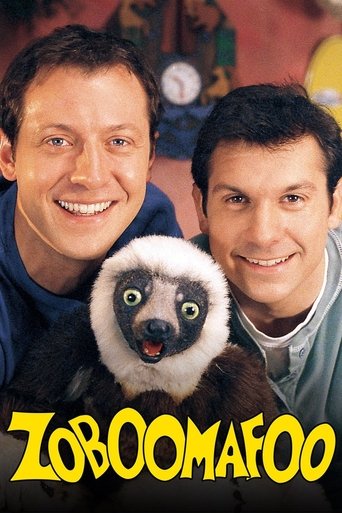
    Synopsis: Zoboomafoo is an American children's television series that aired from January 25, 1999, to April 28, 2001, and is still shown today in syndication depending on the area, and it is regularly shown on PBS Kids Sprout. A total of 65 episodes were aired. A creation of the Kratt Brothers, it features a talking Coquerel's Sifaka, a type of lemur, named Zoboomafoo, or Zoboo for short, and a collection of repeat animal guests. Every episode begins with the Kratt brothers in "Animal Junction", a peculiar place in which the rules of nature change and wild animals come to visit and play. After January 1...

  • Fuet poster

    S3 · E12 9 months ago

    Fuet

  • The Naked Brothers Band poster

    6.5

    S3 · E10 15 years ago

    The Naked Brothers Band

    Synopsis: The Naked Brothers Band is an American musical comedy series created by Polly Draper. The show depicts the daily lives of Draper's sons, who lead a fictional world-renowned rock band from New York City. As a mockumentary, the storyline is a hyperbole of their real lives, and the fictional presence of a camera is often acknowledged. Lead vocals and instrumentation are provided by the siblings; they wrote the lyrics themselves. The show stars Nat Wolff and Alex Wolff, who encounter conflicts with each other that are later omitted. Nat's fictional female admirer and real life preschool friends—in...

  • Standard Deviants TV poster

    8.0

    S2 · E28 24 years ago

    Standard Deviants TV

    Synopsis: Standard Deviants TV comprised material from the Standard Deviants home videos, edited into 25-minute episodes that aired on PBS. The series also included three episodes with new material on geography.

  • The Royal Variety Performance poster

    S66 · E1 10 months ago

    The Royal Variety Performance

    Synopsis: The Royal Variety Performance is a televised variety show held annually in the United Kingdom to raise money for the Royal Variety. It is attended by senior members of the British Royal Family. The evening's performance is presented as a live variety show, usually from a theatre in London and consists of family entertainment that includes comedy, music, dance, magic and other speciality acts.

  • Teenage Mutant Ninja Turtles poster

    8.3

    S5 · E20 8 years ago

    Teenage Mutant Ninja Turtles

    Synopsis: The Teenage Mutant Ninja Turtles are back in an all-new animated series on Nickelodeon! Surfacing topside for the first time on their fifteenth birthday, the titular turtles, Leonardo, Michelangelo, Raphael and Donatello, find that life out of the sewers isn't exactly what they thought it would be. Now the turtles must work together as a team to take on new enemies that arise to take over New York City.

  • Sesame Street poster

    7.1

    S56 · E13 5 months ago

    Sesame Street

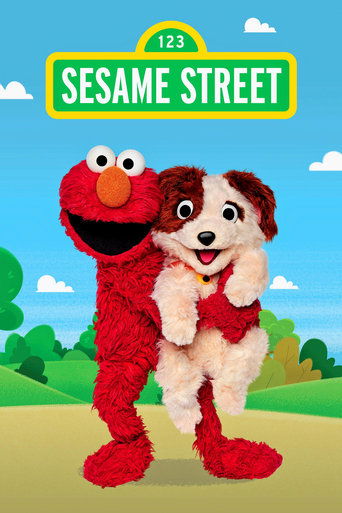
    Synopsis: On a special inner city street, the inhabitants—human and muppet—teach preschoolers basic educational and social concepts using comedy, cartoons, games, and songs.

  • Rugrats poster

    7.6

    S9 · E31 22 years ago

    Rugrats

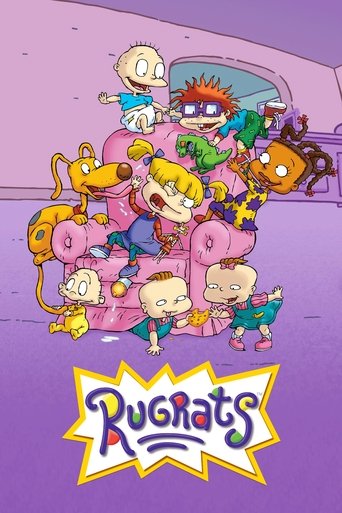
    Synopsis: Focuses on a group of toddlers, most prominently Tommy, Chuckie, Phil, Lil, and Angelica, and their day-to-day lives, usually involving common life experiences that become adventures in the babies' imaginations. Adults in the series are almost always unaware of what the children are up to; however, this only provides more room for the babies to explore and discover their surroundings.

  • Ninjago: Masters of Spinjitzu poster

    8.0

    S16 · E30 4 years ago

    Ninjago: Masters of Spinjitzu

    Synopsis: When the fate of their world, Ninjago, is challenged by great threats, it's up to the ninja: Kai, Jay, Cole, Zane, Lloyd and Nya to save the world.

  • My Little Pony: Friendship Is Magic poster

    8.2

    S9 · E26 7 years ago

    My Little Pony: Friendship Is Magic

    Synopsis: Journey to the enchanted land of Equestria, where unicorn Twilight Sparkle and her pals have adventures and learn valuable lessons about friendship.

  • Fuse poster

    7.6

    S47 · E136 18 years ago

    Fuse

    Synopsis: Fitil is a popular Soviet/Russian television satirical/comedy short film series which ran for about 500 episodes. Some of the episodes were aimed at children, and were called Фитилёк, Fitilyok, Little Fuse. Each issue contained from the few short segments: documentary, fictional and animated ones. Directed by various artists, including Leonid Gaidai who presented his famous trio of Nikulin, Vitsin and Morgunov into the cast. It was called in USSR as "the anecdotes from the Soviet government".

  • Great Performances poster

    6.1

    S55 · E4 1 week ago

    Great Performances

    Synopsis: The best in the performing arts from across America and around the world including a diverse programming portfolio of classical music, opera, popular song, musical theater, dance, drama, and performance documentaries.

Never miss Bill Nye the Science Guy.

Download Streambay and follow Bill Nye the Science Guy. We’ll notify you the moment a new episode is released. It’s free, with no sign-up and no personal information required.

Coming soon to App Store Get it on Google Play
Bill Nye the Science Guy Get new episode alerts Get alerts